
If you have been trying to decide whether next month’s budget should go to Local Services Ads or Google Ads, you are not alone. A lot of plumbing, HVAC, and roofing shops treat them like one product with two names. They are not.
Local Services Ads charge when a homeowner calls or messages you. Google Ads Search usually charges when someone clicks through to a page you control. One is built for the Friday-night leak. The other is built for the water heater someone will quote three times.
This guide is for the owner or office manager who has to choose where the money goes. You do not have to pick one forever. Most shops that sell both emergency and planned work run both, then shift spend by season.
If you work in Canada, take a little extra care. Categories and timing can differ by country. The 2026 move into Google Ads has been rolling out in the U.S. first. Check your own account before you rebuild a Canadian budget around U.S. dates.
Local Services Ads vs Google Ads
When the work is same-day and the homeowner just wants a name and a phone number, Local Services Ads are usually the better fit. When someone is comparing quotes, Search ads give you more control over the keywords, the ad, and the page they land on.
| Job type | Lean toward | Why |
|---|---|---|
| No AC, a slab leak, a tree on the service line | Local Services Ads, where available | High immediate intent; you pay for the lead |
| Remodel, replacement, “who is best / cheapest” | Google Ads Search | People compare; you control keywords, ads, and the landing page |
| A mix of emergency and planned work | Both | Different searches show up in different places |
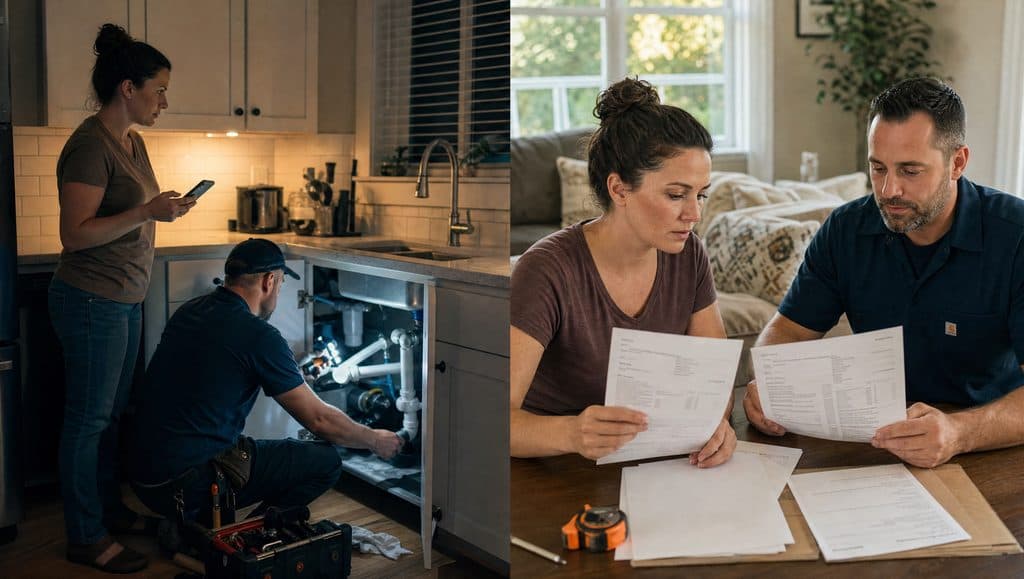
A same-day leak and a quote someone will shop are two different jobs, even in the same trade.
What Local Services Ads are
Local Services Ads are Google’s ads for eligible trades. They sit near the top of relevant searches. You pay when someone calls or messages you, not for every click.
That is why they fit urgent work. The homeowner is not browsing a gallery. They want someone who can come out. LSA can still bring calls while a website is being rebuilt. Search ads are harder on a thin page, because you pay for the click before the phone rings.
The Google Verified badge
If your team still says “Google Guaranteed,” it is time to update the language. In late 2025 Google changed the badge to Verified, and the old money-back story ended. Homeowners still see that Google reviewed licensing and insurance. They do not see a promise the job will close.
Make sure quotes and the website do not promise a badge Google no longer uses. One U.S. vendor has published rough ranges for time-to-live and cost per lead. Treat those as samples, not a quote for your city or a Canadian number.
When Google Ads Search makes sense
Search ads are still the better tool for planned work. Think of a roof estimate, a furnace quote, or a bathroom remodel. You choose the searches, write the ads, and send people to a page you own.
The page has to match the ad. If the ad talks about a tankless install, the page should talk about tankless installs, with a phone number that is easy to tap. Send a furnace ad to a homepage that lists five trades and you often pay for research, not a booked job.
How they compare
The short version is how you pay and how much control you keep. LSA is narrower. Search lets you shape the keywords, the ad, and the landing page. In 2026, LSA is also moving into the same Google Ads home that Search already uses.
| Local Services Ads | Google Ads (Search) | |
|---|---|---|
| You pay when | A lead Google counts as valid | Someone clicks (or a conversion you set) |
| Best fit | Emergency / same-day | Planned / comparison shopping |
| Website | Can work with a lighter site | Needs a page that matches the ad |
| Control | Narrower LSA experience | Keywords, ads, extensions, landing pages |
| Trust signal | Google Verified badge | Ad plus reviews and proof on your site |
| 2026 ops | Moving into Google Ads / PMax pay-per-lead | Already in Google Ads |
What is changing in 2026
Google has been moving Local Services Ads into the main Google Ads home. Existing LSA accounts are shifting to Performance Max campaigns that still charge per lead, instead of the old standalone dashboard. In the United States that shift started in August 2026.
In practice, budget, login, and reporting may sit in one place. The person who ran LSA from the old console will need to get comfortable in Google Ads.
If you get a migration email, treat it as go time. Do not pause just because the screen is changing. Clean up the business name, address, phone, licensing, and insurance first, and export what you can. Past performance numbers may not come with the account.
We will not guess the exact date for Canada or Ontario, or how bidding will feel day to day. That needs a look inside the live account.
When to use LSA, Ads, or both
Lean on Local Services Ads when callers need help today or tomorrow and your office can call back quickly. A website rebuild is not a reason to go dark if LSA is available in your category.
Lean on Search ads when the job is quoted and compared. You will want a landing page with a clear offer, and the ability to turn off searches that waste money.
Most HVAC and plumbing companies need both, because storm month is not the same as quote-shopping month. Once a month, look at the jobs you actually booked. That is a better guide than a single “marketing leads” number.
Things to check before you spend more
There are a few practical things to get in order before you raise the budget.
- Callback speed. A missed LSA call wastes money the same way a wasted Ads click does.
- Landing pages for Ads. Do not send a furnace ad to a homepage that talks about five trades.
- Separate tracking. Follow LSA leads to booked jobs, and Ads clicks to booked jobs. Mixing them hides which channel is paying off.
- Verified documents. Keep licensing and insurance current so you do not lose the badge mid-season.
- Name, address, and phone. Get those matching across Google before your category moves.
How we can help
HOMESHOWOFF works with contractors on this kind of mix. That usually means looking at the jobs you want, the capacity you have, and whether LSA, Search ads, or both make sense right now. We also help keep Verified details and Ads structure in order while Google brings the products together.
If you would like a second set of eyes, get in touch. We are happy to look at what is live in your market before anyone rebuilds a budget.
Frequently Asked Questions
LSA bills a call or a message. Search ads usually bill a click to your website. Use LSA when someone needs help now. Use Search when they are still comparing quotes.
You pay when Google counts a call or message as a valid lead, not for every time your ad is shown. The amount depends on your trade, city, and season. Published U.S. ranges are only a starting point.
Yes. The old Guaranteed name went away in late 2025. The badge is now Verified, and the money-back story is gone. It still means Google checked license and insurance, not that the job will close.
A moving dashboard is not a reason to pause on its own. Save your reports, fix name, address, phone, and license mismatches, and act when the migration email arrives. Old lead history may stay behind.
Not always. What is available in a Canadian city can differ from a U.S. city. Confirm inside your own account before you copy a U.S. timeline.
When you sell both emergency and planned work. Most plumbing and HVAC shops do. Keep LSA for same-day calls and Search for replacements and remodels.