
Are you thinking about pausing SEO when jobs slow down and the trucks come back to the yard? You are not alone. Every fall, we hear from renovation companies, general contractors, and trades professionals who wonder whether SEO for construction is worth the spend when leads dip in colder months.
The logic feels sound: fewer exterior projects, quieter phones, tighter cash flow — so why keep paying for marketing? The problem is that search rankings do not pause when your job site does. Google keeps ranking active competitors, homeowners keep researching indoor projects and spring renovations, and the 60-to-90-day lag in SEO means work you stop in November may not show up as lost traffic until February or March.
With so many variables in play, it can be hard to know what to cut and what to keep. This guide answers whether you should pause SEO in the winter, what happens when you do, and what to work on instead — by trade, by budget, and with a 90-day checklist. For trade-specific strategy, see our SEO services hub and remodeling marketing guide.
Keep in mind: SEO for construction is not a light switch you flip off in October and back on in March. Rankings compound — and so does the cost of stopping.
Why Construction SEO Slows Down in Winter
When it comes to home renovation and construction, revenue often follows the seasons. Leading up to summer through early fall, many remodelers and GCs stay busy. From late fall through early winter, site traffic and booked jobs can dip — especially for exterior work in northern climates.
In marketing, this predictable yearly pattern is called seasonality. One of the first things to keep in mind: a slowdown in booked jobs is not the same as a slowdown in search demand. DataForSEO shows U.S. search interest for seo for construction dips in February but does not hit zero — and keywords like hvac repair near me actually peak in January and February when heating systems fail.
Homeowners also research long before they hire. Kitchen and whole-home remodel decisions often start months before the first demolition day. If your site goes quiet all winter, you miss the research window — even if your crew is idle until spring.
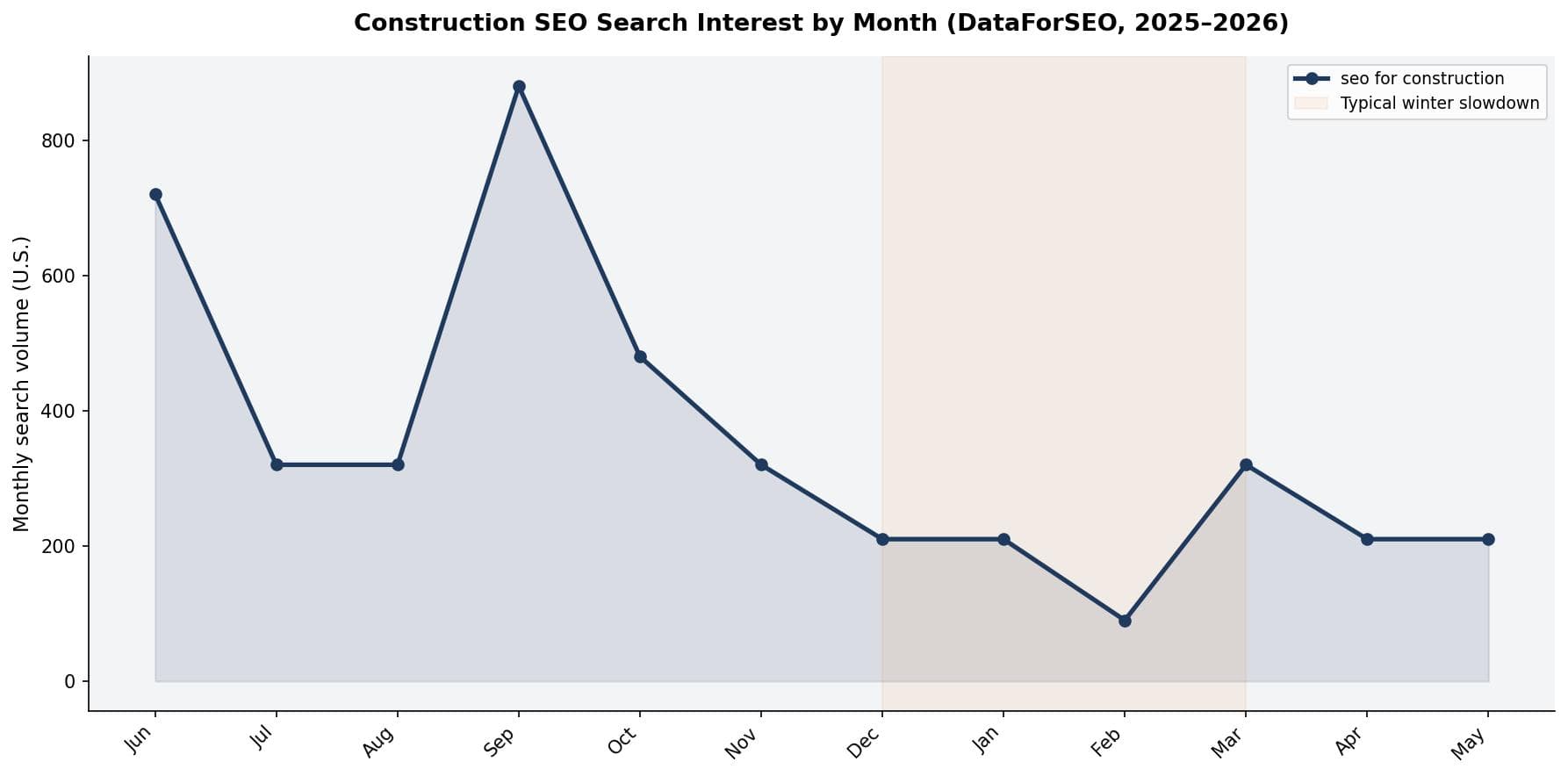
Key takeaway: Winter slows jobs for many trades, but search behavior does not stop — it shifts toward planning, indoor projects, and emergency trades like HVAC.
Should You Pause Your SEO in Slower Months?
The short answer for most construction and renovation contractors: no — do not pause SEO entirely. Reduce scope if you must, but stopping for three to five months usually costs more than it saves.
Contractors on Reddit and marketing forums in 2026 repeat the same mistake: assuming rankings will “hold” during a pause. They do not. seo.com and multiple agency case studies show organic visibility decays over weeks and months — faster on competitive keywords — while competitors who stay active move up.
Angi notes that winter can be a smart time for interior remodels because contractors are less busy and may offer better scheduling. That same logic applies to SEO: winter is when you have time to fix the site, publish content, and prepare for the spring rush — not when you go dark.
Key takeaway: Pausing SEO saves cash short term but creates a catch-up tax in spring — lost rankings, lost research-phase visibility, and competitors who kept going.
What Happens When You Stop SEO
SEO is not like paid ads. When you pause a Google Ads campaign, traffic stops immediately. When you pause SEO, the decline is gradual — which makes the damage easy to miss until it is expensive to fix.
Within a few months, most contractors see:
- Lower rankings on competitive keywords as competitors publish, earn links, and update profiles
- Declining organic traffic — one agency case study saw traffic cut to one-third after a 3-month SEO stop
- Fewer conversions from search as visibility drops, often forcing reliance on paid ads
- Technical decay — unmonitored sites lose schema markup, break links, or miss platform updates
- Missed new searches — Google sees millions of queries it has never seen before; silent sites cannot capture them
NP Digital research cited by 39 Celsius (Oct 2025) found companies that stopped blogging saw a 39.7% drop in SEO traffic, versus an 18.2% dip for those that kept publishing. Pausing does not freeze your position — it reverses momentum.
If you are weighing whether SEO is worth ongoing spend, see how much SEO costs and compare it to the cost of rebuilding visibility from scratch.
Key takeaway: Stopping SEO creates a deficit you pay back later — with interest — in rankings, traffic, and emergency ad spend.
Why Winter Is the Best Time to Invest in SEO
SEO has a real lag between effort and results. ATS Creative (2026) estimates 60 to 90 days before Google fully evaluates and rewards many changes. If you wait until the first warm week in March to restart, you may not see the benefit until May or June — well into the season you wanted to capture.
Launch SEO in November or December, and meaningful visibility can arrive by March or April — when remodel, HVAC, and exterior trades see demand return. That is why winter is often the best time to invest, not the best time to quit.
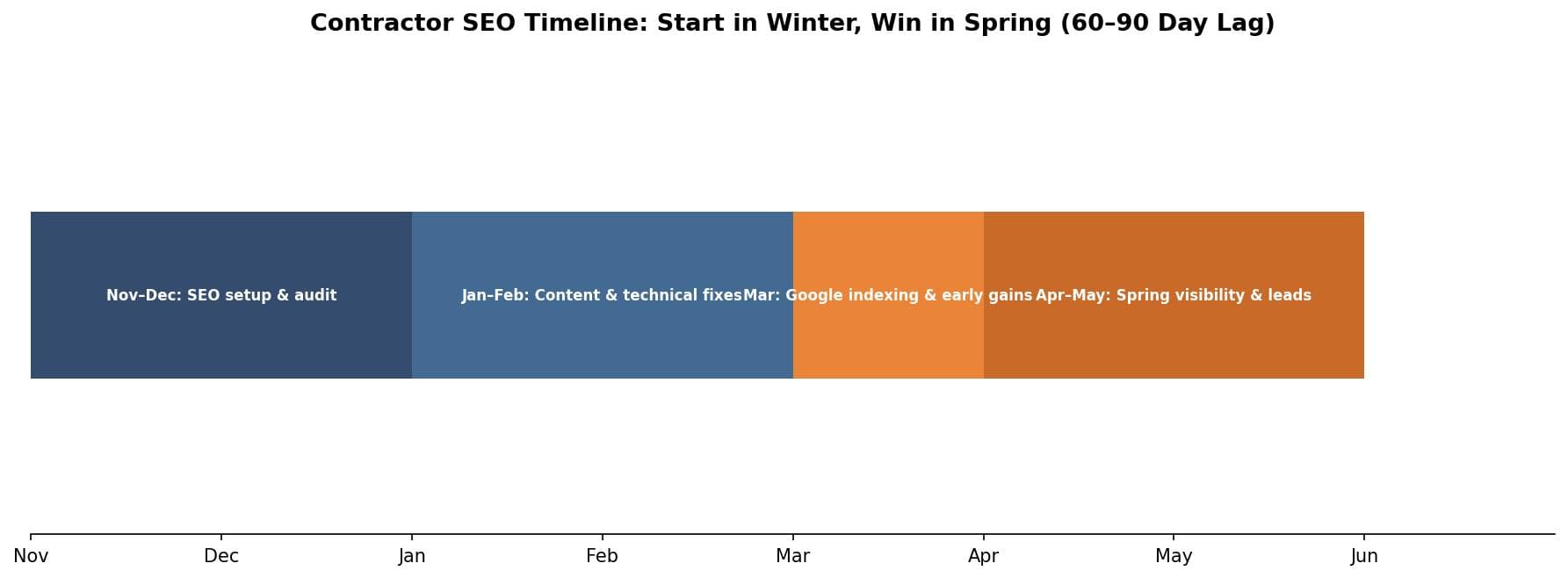
Key takeaway: Winter SEO work is an investment in spring pipeline — the shortlist gets built while homeowners research, not when they finally call.
SEO Tasks to Run During the Slow Season
There are several things you can do during slow months that are hard to fit in when every crew is booked. Use winter for the behind-the-scenes work that compounds:
- Audit Google Business Profile — fresh photos, services, holiday hours, weekly posts
- Fix technical issues — broken links, slow pages, missing schema, mobile errors
- Update service pages — kitchens, baths, basements, HVAC, roofing by season
- Publish helpful content — budget guides, timeline posts, permit explainers
- Refresh citations — consistent name, address, phone across directories
- Reply to every review — including older feedback you never answered
- Plan spring content — batch posts in winter, publish on schedule in March
Killerspots Agency (Nov 2025) recommends using winter to polish high-traffic pages, fix small technical issues, and align website copy with your other marketing — so when spring searches spike, your site is ready.
For local fundamentals, our local promotion guide covers GBP, reviews, and community channels in detail.
Key takeaway: Slow season is maintenance season — the work you skip in winter is the work you pay for in lost spring leads.
Winter Marketing and SEO by Trade
Seasonality is not one-size-fits-all. Depending on your trade and market, winter affects jobs and search differently:
Angi (Apr 2026) recommends scheduling interior basement and room remodels in winter when contractors are less busy — and reaching out in late summer or early fall to get on their winter schedule. The same planning applies to SEO: start winter content now for trades you want more of in Q2.
Trade-specific help: remodeling SEO, HVAC SEO, roofing SEO.
| Trade | Winter job demand | SEO priority in slow months |
|---|---|---|
| Kitchen / bath remodel | Lower installs; higher planning | High — buyers research now, book in spring |
| HVAC / heating | High (emergency + tune-ups) | Medium — maintain; capture heating keywords |
| Roofing | Medium (storms, ice damage) | Medium — emergency + inspection content |
| Painting / flooring (interior) | Medium | High — indoor project galleries and FAQs |
| Exterior remodel / landscaping | Low | High — best time for site/content work |
| General contractor / whole-home | Mixed by region | High — long research cycles start in winter |
Key takeaway: Match your winter SEO plan to your trade — HVAC may need maintenance-mode SEO, while remodelers should lean hard into research-phase content.
If Budget Is Tight: Reduce Scope, Don’t Stop
We hear from Midwest contractors and seasonal trades every year: cash flow tightens in winter, and marketing is the first line item cut. If a full retainer is not realistic, trim the scope — do not cancel entirely.
| If budget is tight… | Do this | Do not do this |
|---|---|---|
| Full SEO retainer | Drop to technical care + 1 blog/month | Cancel and assume rankings hold |
| Content production | Batch 3 posts in winter; publish in spring | Delete old blog posts or let site go stale |
| Google Business Profile | Weekly photo + review replies | Leave profile untouched 90+ days |
| Paid ads | Lower daily budget temporarily | Assume organic will cover the gap |
| Agency support | Ask for a winter maintenance tier | Disappear until March and expect instant recovery |
Key takeaway: A reduced SEO plan beats a full stop — every month offline makes spring recovery more expensive.
2026 Updates: AI Search and Seasonal SEO
SEO in 2026 is not just about blue links. Google AI Overviews, ChatGPT, and Maps recommendations pull from structured, trustworthy local content — the same foundation as traditional SEO.
One of the first things to understand: pausing SEO also pauses the technical maintenance that keeps you visible in AI answers. Schema markup, fresh content, review velocity, and GBP activity all signal that your business is active and credible. Sites that go stale are less likely to appear when homeowners ask AI tools for contractor recommendations.
Google also continues to emphasize profile freshness and real business data — accurate hours, services, and photos matter when AI-assisted calling or Search features contact you on a customer’s behalf.
For a deeper look at AI visibility for contractors, see AI SEO for contractors.
Key takeaway: AI search rewards the same habits as local SEO — consistency, fresh content, and accurate business data. Winter is not the time to go silent.
Your 90-Day Winter SEO Checklist
If your SEO has been on autopilot, here is a practical 90-day plan most construction and renovation contractors can follow:
Days 1–30: Audit and fix
- Run a technical audit — speed, mobile, broken links, schema
- Audit Google Business Profile — categories, photos, services, hours
- Identify top 5 pages by traffic; plan refreshes for those first
- Set up review request process for every completed job
Days 31–60: Content and local
- Publish or refresh one high-intent service page
- Write one blog post answering a common winter research question
- Post 2–4 GBP updates (project photos, seasonal tips)
- Fix NAP consistency across top directories
Days 61–90: Prepare for spring
- Publish spring-focused landing page or FAQ
- Batch 2–3 blog posts for March–April publishing
- Check Search Console for rising impressions
- Track lead source on every inquiry — know what winter work produced
Key takeaway: Ninety days of steady winter SEO beats restarting from zero when the weather turns.
Need Help With SEO for Your Construction Business?
Whether you run a remodeling company, a general contracting firm, or a seasonal trade, the right SEO strategy depends on your market, project mix, and where you are in growth.
You do not have to figure it out alone.
Our team helps contractors across Canada and the U.S. build local visibility that turns into booked jobs — including winter plans that set up spring pipeline. Get in touch today and we will review your site and help point you in the right direction.
Frequently Asked Questions
For most construction and renovation contractors, no. Rankings decay when SEO stops, competitors who stay active gain ground, and the 60–90 day SEO lag means work paused in fall may not hurt until spring — when you need visibility most. Reduce scope if budget is tight, but avoid a full stop.
You can stop SEO at any time, but organic rankings, traffic, and conversions typically decline over the following months — faster on competitive keywords. seo.com and multiple 2025–2026 agency reports treat SEO as ongoing maintenance, not a project with a finish line.
Winter gives you time for technical fixes, content creation, and GBP updates that are hard to fit in during busy season. SEO started in November or December can show meaningful gains by March or April when remodel and exterior demand returns. Competitors who pause also leave openings.
Booked jobs often slow for exterior and seasonal trades, but search behavior shifts rather than stops. HVAC searches peak in cold months; remodelers see planning-phase research; and seo for construction search interest dips in February but remains well above zero.
Prioritize Google Business Profile updates, technical site fixes, service page refreshes, review replies, citation cleanup, and blog content that answers how homeowners research during winter. Batch spring content now and publish on schedule in March.
Yes — especially as AI search and Google AI Overviews pull from trusted local content. SEO builds an asset you own, unlike shared lead platforms. One booked kitchen or whole-home project often covers months of SEO investment for remodelers.
Most contractors see meaningful progress in four to seven months, with stronger results over twelve months. Individual changes may take 60–90 days to fully reflect in rankings. Starting SEO in late fall positions you for spring lead volume.